
LWG Gold Rating · Carbon Neutral by 2030
Sustainability
Leading the leather industry in environmental performance — from our Scottish tannery to every hide we sell.
LWG Gold Rating · Carbon Neutral by 2030
Leading the leather industry in environmental performance — from our Scottish tannery to every hide we sell.
Leather Working Group
The Leather Working Group (LWG) is an independent international body that audits tanneries against a rigorous protocol covering environmental stewardship, supply chain traceability, and chemical management. The Gold Rating is the highest tier — awarded only to facilities that score above 85% across all audit categories.
Muirhead has held the LWG Gold Rating since 2016. The audit is repeated annually by an independent third party, with no allowance for historical performance — each audit cycle stands on its own results. Holding Gold year after year is not a passive achievement; it requires continuous investment in water treatment, energy management, waste reduction and traceability.
For buyers sourcing leather for aviation interiors, where full supply chain documentation is a regulatory requirement, our LWG Gold status provides an independently verified record of environmental compliance that extends from raw hide sourcing through to finished leather despatch.
Water consumption and discharge quality · Energy use and renewable sourcing · Chemical inventory and restricted substance compliance · Waste management and landfill diversion · Social accountability and working conditions · Supply chain traceability to farm of origin
Carbon Footprint
Leather production has a carbon footprint. We do not obscure that. What we do is measure it rigorously, set credible reduction targets, and report annually against independent benchmarks. Our commitment is to carbon neutrality by 2030 — and the path there is funded, planned and already underway.
Our Blyth Bridge facility moved to 100% renewable electricity in 2022, sourced via REGO-certified contracts from Scottish wind generation. This removes the largest single component of our Scope 2 emissions.
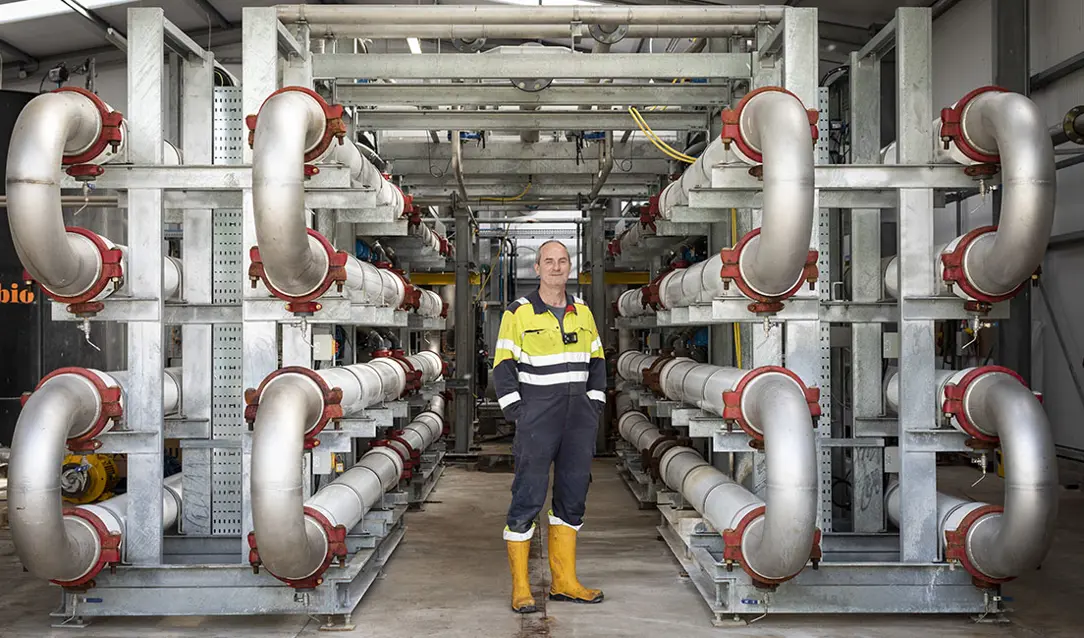
Tanning is a water-intensive process. Our on-site water treatment plant recycles process water back into production at a rate that puts us in the top 10% of LWG-audited tanneries globally for water efficiency.
All solid waste from tanning operations is either reprocessed into by-products or sent to energy-from-waste facilities. We have not sent production waste to landfill since 2019 and have no plans to resume doing so.
We account for Scope 3 transport emissions using carrier-reported data. Our UK distribution network runs on carrier fleets with declared low-emission routing for primary lanes.
Chromium-based tanning has been the dominant chemistry in premium leather production for over a century — primarily because it produces the most durable, stable hides at the widest range of specifications. The environmental and health risks associated with hexavalent chromium (Cr VI) have driven the industry to seek alternatives for decades.
Muirhead's FreeTAN process achieves the critical performance metrics of traditional chrome tanning without chromium salts — and passes aviation flammability testing to FAR 25.853 standards. This is not a compromise product positioned at the commodity end of the market. FreeTAN leather is used in working aircraft cabins.
The Circular Argument
The environmental cost of producing a hide is fixed at the point of manufacture. Allowing that hide to go unused — held in storage, or eventually disposed of — adds no environmental value and represents a waste of the resources already committed. Buying Outlet leather puts existing stock to use, with no additional production required.
Every hide in the Outlet has already been manufactured. Choosing Outlet leather over new production means the carbon, water, and chemical inputs of your purchase are already accounted for — there is no additional environmental cost triggered by your order.
Premium leather is one of the most durable materials available. A Muirhead hide used in an upholstery application will last decades. Diverting excess stock into long-life applications extends the useful life of material that would otherwise occupy warehouse space indefinitely.
An efficient secondary market for excess leather reduces the commercial pressure to minimise buffer stock in primary production. The Outlet creates a transparent, priced route for surplus material — meaning production planning can prioritise quality over tight quantity control.
Carbon Neutral by 2030
Our 2030 commitment is not a communications exercise. Each milestone has a defined investment programme, a verification partner, and an annual public reporting obligation through our LWG audit cycle.
All electricity consumed at Blyth Bridge sourced from REGO-certified Scottish renewables.
Full carbon inventory completed and third-party verified to GHG Protocol standard.
Supply chain decarbonisation programme covering primary raw material sourcing and inbound logistics.
Residual emissions offset through verified nature-based solutions in the Scottish Borders.
Shop sustainably
Every Outlet hide is already made. Your purchase puts it to use — not to waste.